Your Guide to Five Guys Menu Nutrition and Calories
Five Guys Menu Nutrition tells you the calorie and macro picture for popular orders so you can plan an order without guesswork. This guide gives a short, practical answer: learn calories, key macros, and the easy swaps that cut major calories fast.
Five guys servings are large by design. A standard burger has two patties while a “Little” is a single-patty. Removing the bun typically saves about 240 calories, a useful hack when you want fewer carbs.
This intro sets expectations: this restaurant is not marketed as low-calorie fast food, but smart customization helps. The article will cover nutrition facts for burgers, dogs, sandwiches, fries, and milkshakes, plus a reusable customization playbook.
Values can vary by location and serving size, and this is informational, not medical advice. Think in goal-based options—more protein, more balanced, or lower-calorie—so you pick what fits your day. Later sections compare portions to other restaurants like Taco Bell to help set expectations.
How to Use Five Guys Menu Nutrition Information in the United States
A single choice, like patty count, often explains most of the calorie difference between orders. Start by reading the baseline for the sandwich or dog before adding anything else. That base sets most of the calories and macros.
What “Little” vs regular means for calories and macros
Regular burgers come with two patties; a “Little” has one. That often saves 300+ calories and lowers fat while keeping reasonable protein.
| Item | Calories | Protein (g) |
|---|---|---|
| Hamburger | 840 | 39 |
| Little Hamburger | 540 | 23 |
| BLT (with mayo) | — | — |
Why toppings and sauces change facts fast
Toppings and sauces are sold à la carte, so two identical named items can differ widely. Mayo adds about +110 calories, ketchup +30, BBQ +50, mustard +5, A1 +15, hot sauce 0.
Using a guys nutrition calculator mindset
Treat each add-on as a line item: bun, cheese, bacon, mayo. Quick mental math helps you stay on goal.
- Checklist: pick a goal, choose base, pick patty count, then pick sauces and veggies.
- Next: a clear breakdown of menu items with calories and macros awaits.
Five Guys Menu Nutrition: Calories and Macros by Menu Item
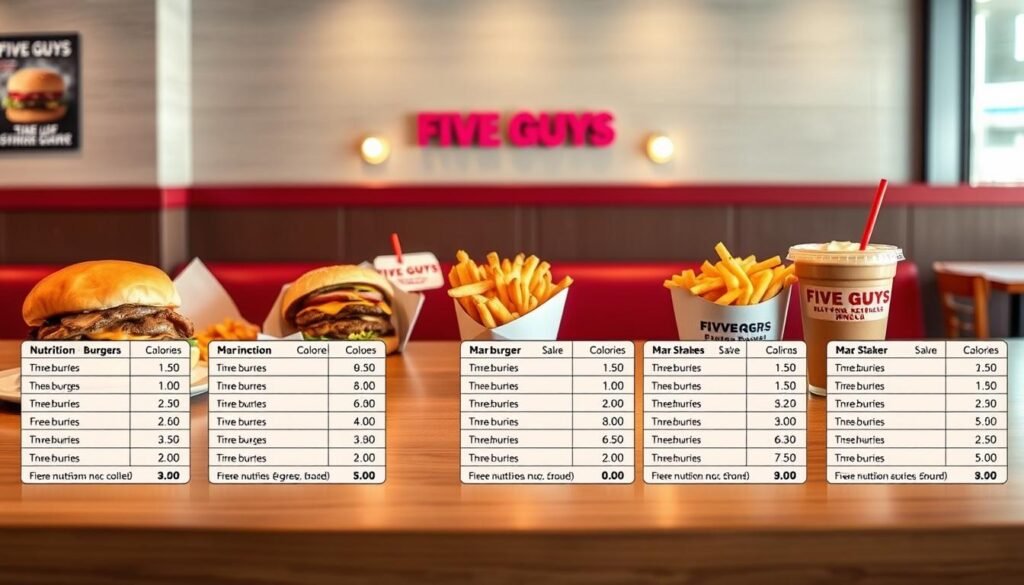
Use this compact guide to compare core items by calories, fat, and protein before you order. Below is a scannable reference for the most common burgers, dogs, and sandwiches in the U.S.
Burgers (baseline, no extra condiments)
| Item | Calories | Fat (g) | Protein (g) |
|---|---|---|---|
| Hamburger | 840 | 43 | 39 |
| Cheeseburger | 980 | 55 | 47 |
| Bacon Burger | 920 | 50 | 44 |
| Bacon Cheeseburger | 1060 | 62 | 52 |
Little burgers (single-patty, more balanced)
Little hamburger options cut major calories while keeping protein. Single-patty builds are often the most macro-balanced choice for someone who wants a classic burger experience.
- Little Hamburger: 540 cal / 26g fat / 23g protein
- Little Cheeseburger: 610 cal / 32g fat / 27g protein
- Little Bacon Burger: 620 cal / 32g fat / 28g protein
- Little Bacon Cheeseburger: 690 cal / 39g fat / 32g protein
Hot dogs and cheese dogs
Dogs are easy to overlook but can match burgers in calories once cheese or bacon are added.
- Hot Dog: 520 cal / 35g fat / 18g protein
- Cheese Dog: 590 cal / 41g fat / 22g protein
- Bacon Dog: 600 cal / 42g fat / 23g protein
- Bacon Cheese Dog: 670 cal / 48g fat / 27g protein
Sandwiches, bunless options, and best-for-goals
Veggie Sandwich is lowest at 280 cal (includes toppings). Grilled Cheese uses the bun plus extra cheese; BLT includes mayo by default. Patty Melt is heavier at 790 cal.
Removing the bun typically saves ~240 calories. Bunless still retains protein and fat from patties, cheese, and bacon—example: bacon cheeseburger without bun ≈ 820 cal / 53g fat / 45g protein.
Quick picks: Most protein — bacon cheeseburger (52g). Most balanced — Little Hamburger/Cheeseburger. Lowest-calorie core sandwich — veggie sandwich (280 cal).
Customizations That Impact Calories the Most
A few simple choices will swing the calorie total of any burger dramatically. The fastest lever is structure: remove the bun and you cut roughly 240 calories. That single change beats fiddling with small add-ons when you want predictable results.
Remove the bun and go bowl-style
Ordering an item without bun keeps patties, cheese, and toppings but drops most bread calories and carbs. Think of this as a bowl or lettuce-wrap—fork-friendly and repeatable for tracking nutrition facts.
Cheese, bacon, and patty choices
Cheese adds about +70 calories; bacon adds +70 each. Stacking cheese plus bacon is roughly +140 before sauces. Remember regular burgers include two patties, so patty count is a big driver of totals.
Condiments and sauce impact
Mayo is the standout calorie adder at +110. Ketchup adds ~+30, BBQ ~+50, A1 +15, mustard +5, and hot sauce is negligible. Ask for sauce on the side to control portions and keep your nutrition tracking consistent.
- Build example — lower: Little burger + veggies + mustard = lower calories and solid protein.
- Build example — indulgent: Regular + bacon + cheese + mayo = much higher calories quickly.
| Change | Calories | Notes |
|---|---|---|
| Remove bun (bowl-style) | -240 | Less carbs; fork-friendly |
| Add cheese | +70 | Dairy allergen |
| Add bacon | +70 | High fat |
| Mayo | +110 | Highest sauce calorie |
Allergens: cheese and mayo contain dairy; BBQ and ketchup add sugars; gluten risk mainly comes from the bun and cross-contact. Mini rule-of-thumb: pick one indulgent add-on (cheese or bacon or mayo) rather than stacking all three if calories are your priority.
Five Guys Fries Nutrition: Portion Size, Calories, and Cajun Style
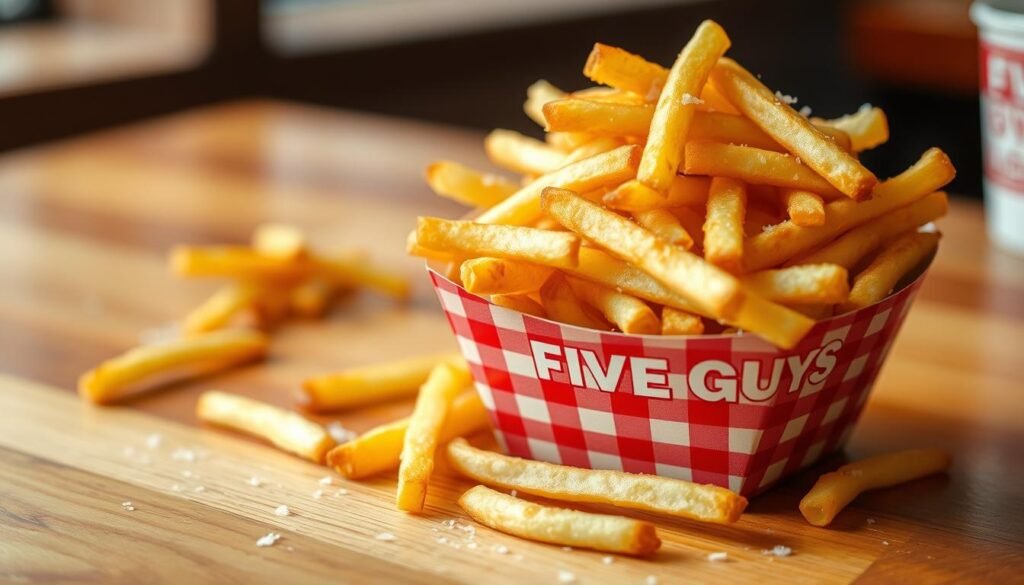
Portion size is the single biggest surprise on the fries lineup for many diners.
The “little fries” here weigh about 227g, which is heavier than many people expect. For comparison, a Burger King large fries is roughly 173g. That means a large order at this chain can equal about 3.5 Burger King large fries by weight. In practice, higher calories track with weight and oil absorption, not a secret recipe.
Why calories run high
Heavier portions plus deep-fry oil raise the calorie count quickly. Cajun style only adds seasoning and a perception of salt; calories stay tied to portion and oil.
Practical ordering strategies
- Split an order with a friend to halve calories and still get the crisp texture you want.
- Order the smallest size on purpose, or skip fries when you add a shake or dessert.
- If you choose a regular two-patty burger, consider skipping fries; if you pick a Little burger, a shared fries may fit your goals.
| Item | Weight (g) | Notes |
|---|---|---|
| Little fries | 227 | Vegetarian-friendly; check cross-contact for vegan or gluten-free |
| Burger King large fries | 173 | Used for portion comparison |
| Cajun style fries | Same | More spice and sodium perception; calories unchanged |
Dietary note: Fries are typically vegetarian but may not be vegan-safe due to handling. Cross-contact can affect gluten-free claims—confirm at the counter.
Planning line to remember: at this spot, fries are a second entrée—order them like it.
Milkshake Nutrition at Five Guys: Base Calories and Mix-Ins
A rich milkshake can add as many calories as a full meal, even before any mix-ins. The single-size vanilla base is already 670 calories, with 32g fat and 13g protein. That means even a plain shake is a full dessert choice on the menu.
Mix-ins that raise calories fast
Some add-ins add a huge number to the total. Peanut butter and Oreo crème each add about +320 calories. Reese’s cups add +150, and salted caramel adds +155.
Lower-impact mix-ins and practical options
Smaller add-ins include whipped cream (+20), Oreo cookies (+120), chocolate (+130), strawberry (+90), banana (+160), and bacon (+70). Pick one premium mix-in rather than stacking three to keep totals reasonable.
- Practical tip: split the shake or save half for later since only one size is offered.
- Allergens: dairy is inherent; peanut butter and Reese’s introduce nut concerns and cross-contact risk.
- Treat strategy: choose one indulgent mix-in, add a small texture topper, and skip extra fries if needed.
| Item | Calories | Notes |
|---|---|---|
| Shake base (single) | 670 | 32g fat • 13g protein |
| Peanut butter (mix-in) | +320 | Nuts allergen; largest add-in |
| Oreo crème (mix-in) | +320 | High sugar; cookie texture |
| Salted caramel (mix-in) | +155 | Sweet, mid-range calories |
| Reese’s Cups (mix-in) | +150 | Contains nuts; high sugar |
Conclusion
A few repeatable moves let you tailor each order without complex math. Start with a Little for a more balanced baseline. Skip the bun to drop ~240 calories. Treat mayo as a major add-on (+110) and ask for sauce on the side.
Remember fries are large—share them. A shake is a dessert: the base alone is about 670 calories before mix-ins. Use these deltas (bun, cheese, bacon, sauces) to estimate totals rather than tracking every bite.
For goals: most protein — bacon cheeseburger; lowest-calorie main — veggie sandwich; best everyday middle — Little Hamburger or Little Cheeseburger with veggie toppings. Confirm allergens (nuts, dairy) and gluten handling in-store.
You can make five guys fit your routine when you order with intention and know where the calories come from.